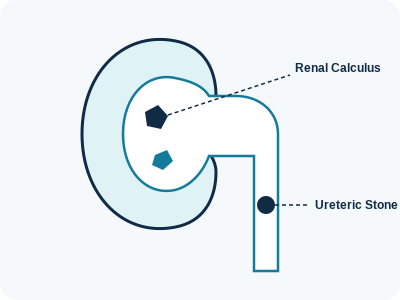
When kidney stones require procedural removal, urologists select the approach based on stone size, number, hardness, location within the kidney, and patient anatomy.

What Is RIRS?
RIRS uses a flexible ureteroscope passed naturally through the urinary tract to reach kidney stones and break them with laser energy without an external skin incision.
What Is PCNL?
PCNL creates a small keyhole channel directly into the kidney to fragment and extract larger or more complex stones efficiently.
How Urologists Decide
Smaller or moderately sized stones in suitable locations are often addressed via RIRS, while larger or staghorn stones frequently favour PCNL. Your urologist will explain the options suited to your scan results.
Recovery and what to expect
After RIRS many patients go home within a day. A temporary stent is often placed and can cause urgency, frequency or mild discomfort until it is removed. After PCNL the hospital stay is usually a little longer, and a small drainage tube may be left in place for a short time.
Mild blood in the urine is common after both procedures and usually settles within days. Fever, heavy bleeding or severe pain should be reported straight away.
Risks to discuss with your surgeon
- Infection, which is why urine is tested and treated before surgery
- Bleeding, which is more relevant after PCNL
- Remaining fragments that may need a further procedure
- Stent discomfort and the need for a short procedure to remove it
Questions to ask before deciding
- Why is this approach recommended for my stone?
- Will I need more than one procedure?
- Will a stent or drainage tube be left, and for how long?
- What can I do to prevent new stones?
Have a question about your symptoms?
Choose your preferred hospital and request a consultation. Your enquiry opens in WhatsApp and is sent only when you press Send.